THE QUESTION BEFORE US
Does the Qur’an disclose knowledge beyond human observation and inference?
Choose a verse number, book icon or underlined word to read more here.
Does an image establish a discovery?
Qur’an describes human formation through a drop, an , a , bones clothed with flesh, and another creation. Pickthall’s 1930 English renders the middle terms as a clot and a little lump. A scientific-miracle argument reads these stages as knowledge that a seventh-century human could not have possessed. The question is whether the wording uniquely establishes that claim.
A Muslim scientific-miracle argument reads as a leech-like or clinging embryo and as something chewed. The embryo clings, its shape can suggest a leech, and its surface can suggest tooth marks. Those are possible comparisons. The issue is whether they identify a precise discovery unavailable through ordinary observation and thought, rather than a resemblance selected after modern images became available.
Clot, leech and clinging: all known.
Classical Arabic gave more than one sense. Edward Lane's Arabic-English Lexicon, which gathers the medieval lexicographers, lists the small blood-sucking creature found in water, the leech, and "clotted blood, before it becomes dry", and applies the second sense to the seed "when it becomes thick, clotted, blood", the stage before it becomes a .
Ibn Kathir’s fourteenth-century commentary already combines the senses. He describes a red , elongated like a leech, and transmits Ikrima’s explanation that it is blood. He describes the as a morsel without formed features, then flesh covering and strengthening the bones. Al-Qurtubi, commenting on 96:2, explains as moist blood named for its clinging. The clot, leech and clinging interpretations therefore predate modern microscopes.
The literal blood-clot interpretation is not modern embryology. Anatomical specimens show an early embryo organizing cell layers and structures, not reproductive fluid becoming a coagulated mass of blood. An embryo can contain blood without being a blood clot. A Muslim can instead choose the clinging or leech comparison, but that changes the proposed anatomical claim; it does not turn the classical clot explanation into an accurate microscopic account.
Ibn Kathir on 23:12-14 (Arabic) al-Qurtubi on 96:2 (Arabic) UNSW · Carnegie stage 7 anatomical specimens
A morsel or chewed-looking shape is not so anatomically specific that only revelation could suggest it. Long before Islam, Aristotle’s History of Animals VII.3 discussed examining miscarried embryos and their visible parts. His account contains errors, including different male and female development timelines; it still shows that embryonic form was a subject of human observation and speculation. The old leech, clot and clinging explanations likewise preceded modern imaging. A word broad enough to accommodate a later photograph does not establish the supernatural foreknowledge claimed for it.
Ibn Kathir on 23:12-14 (Arabic) al-Qurtubi on 96:2 (Arabic) Aristotle · History of Animals VII.3
Does prenatal descent explain adult fluid?
Qur'an describes creation from a gushing fluid issuing between the loins and ribs. Ibn Kathir transmits a reading involving the man's backbone and the woman's chest. Al-Qurtubi initially makes the fluid the subject, but also records a reading in which the human comes forth. Interpretation therefore matters before anatomy can test the claim.
Qur’an 86:6–7 Ibn Kathir · Qur’an 86:7 (Arabic) Al-Qurtubi · Qur’an 86:7 (Arabic)
Semen is not produced in the chest: sperm are made in the testes, while most ejaculate comes from seminal vesicles and prostate near the bladder. A serious modern Muslim reply points to something real: testes begin developing high in the abdomen near the kidneys, then descend. Some defenders also appeal to blood and nerve supply. Broader readings treat the passage as parental or torso language rather than a precise map of glands.
NCI · seminal-fluid glands NCI · testes and development Islam Q&A · the gonad-descent reply Asadullah Ali · a parental reading
But the prenatal position of developing testes and the adult emission of reproductive fluid are different events. The verse does not name developing gonads or their descent. Showing that the organs once lay higher does not show that gushing fluid issues from that former site. Citing blood and nerves does not establish where semen is made. Broader parental readings may avoid this anatomical objection; they do not thereby predict testicular descent. The conclusion is specific: a reading locating semen's source in the chest conflicts with anatomy, while these words do not establish a uniquely precise scientific miracle.
A crustal root is not an earthquake shield.
Qur'an and describe firm mountains keeping the earth from shaking with its inhabitants. Ibn Kathir explains that mountains make the earth settle rather than sway and disturb the creatures living on it; al-Qurtubi likewise explains the movement as swaying from side to side. This is a claim about a function, not simply mountains' visible height.
Qur’an 16:15 Qur’an 21:31 Ibn Kathir · Qur’an 16:15 (Arabic) Al-Qurtubi · Qur’an 16:15 (Arabic)
The strongest Muslim reply points to real geological structure: mountains can have deep crustal roots, and isostasy describes buoyant support. Stability need not mean that no earthquake ever occurs. But roots supporting elevated terrain are not automatically pegs preventing tectonic motion. The US Geological Survey explains that collision and continuing underthrusting in the Himalaya generate numerous earthquakes, making the region exceptionally hazardous. The same ongoing tectonic system involves uplift, deformation and fault slip.
Islam Guide · mountains and roots Hong Kong Observatory · isostasy USGS · Himalayan tectonics and earthquakes

Mountain earthquakes alone cannot disprove every possible comparative stabilizing effect. Equally, pointing to roots does not establish the further causal claim that they reduce shaking. An interpretation promising immobility or immunity from earthquakes conflicts with observation; a broader claim of habitability or relative stability is less specific and needs its own evidence. The justified verdict is that modern geology has not been predicted merely by calling mountains stabilizers. A real crustal root is not proof that the verse uniquely foretold its structure or physical effects.
What does the sunset verse establish?

Qur'an describes Dhu al-Qarnayn finding the sun setting in a muddy spring. The received readings also include , hot, alongside , muddy. Neither reading describes modern astrophysics.
It would nevertheless be unfair to insist that this must mean the sun physically entered a small pool. Ibn Kathir, writing centuries before modern science, explained it as the sight of sunset at the ocean: the observer sees the sun as though it enters the water. Al-Qurtubi likewise preserves a premodern explanation that the sun is too large to enter an earthly spring. A Muslim can therefore answer the familiar objection without inventing a new interpretation.
Ibn Kathir · Qur’an 18:86 (Arabic) Al-Qurtubi · Qur’an 18:86 (Arabic)
We Christians also use ordinary language about sunrise and sunset. But a description compatible with what a traveller sees is not a scientific discovery unavailable to his contemporaries. On the appearance reading, the verse describes an ordinary visible scene and supplies no extraordinary astronomical information.

The responsible verdict is therefore neither an unavoidable physical error nor a scientific miracle. The wording calls for interpretation, and the classical appearance reading is a serious option. This case undercuts careless polemic and exaggerated scientific apologetics alike. Whether the speaker has divine authority requires stronger evidence than an ordinary sunset.
The Arabic does not say “chromosomes and genes”.

In Sahih Muslim 315a, Thawban reports that Muhammad described a man's white fluid and a woman's yellow fluid: when the man's prevails, they produce a boy; when the woman's prevails, a girl, by God's permission. This concerns sex, unlike related reports about family resemblance. Sunnah.com's English includes “ovum central portion” and “chromosomes and genes” in parentheses. Those explanations are absent from the Arabic. A translator's additions cannot establish what the original speaker knew.
In the usual human XX/XY pathway, an egg contributes X, while the fertilizing sperm contributes X or Y. Sexual development also involves other genes and variations. This is a specific biological mechanism; the relative predominance of two differently coloured fluids does not describe it.
Muslim biologist Bilal Ghareeb proposes that conditions in the woman's reproductive tract might favour particular sperm. That is a possible reconciliation to investigate, not a human experiment confirming this report. There is also a premodern response: Ibn al-Qayyim records his teacher's doubt about the preservation of the sex wording. That challenges the wording instead of proving its genetics. Whether one adopts reinterpretation or textual criticism, this passage has not supplied an independently demonstrated discovery of chromosomes. The modern explanation must be established from the Arabic and evidence, rather than inserted between its lines.
Ghareeb 2011 · a Muslim biological proposal Ibn al-Qayyim · the sex-wording objection (Arabic)
A laboratory result is not a safe drink.
Sahih al-Bukhari 3320 attributes to Muhammad an instruction to immerse a fly that falls into a drink, then remove it, because one wing carries disease and the other healing. The Arabic does not identify a right or left wing. The claim concerns what happens in a drink, not merely the existence of useful chemicals somewhere in an insect.
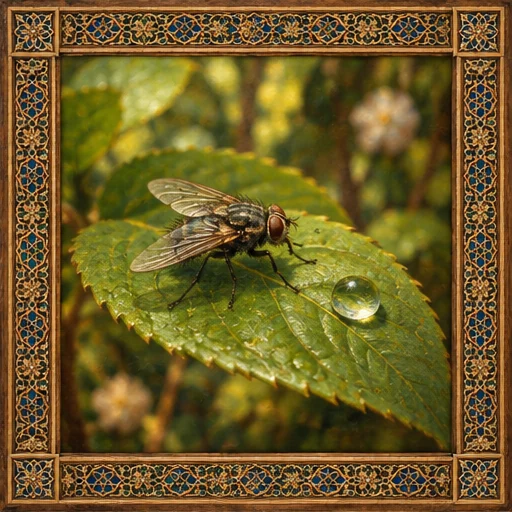
Muslim defenders point to real antimicrobial defences in houseflies: a 2017 experiment identified the protein AMP17 and demonstrated activity against microbes. An animal can carry pathogens while producing substances that inhibit them. The combination is biologically possible.
A 2020 study went closer to the report, adding detached right wings to water containing E. coli and reporting no colony growth. But it used only two repetitions per treatment. It did not compare immersing and removing ordinary whole flies, test the full range of contaminants, or measure illness in people. Its laboratory result therefore cannot establish reliable safety under the conditions described by the .
Official public-health guidance identifies houseflies as a means of food contamination. Discovering a promising antimicrobial does not demonstrate that dipping a contaminated insect neutralizes its hazards. The cited experiments give reasons for further research; they do not provide scientific confirmation of the practical instruction. That conclusion concerns the reach of the evidence, without claiming that an insect could never contain a useful remedy.
A nutritional effect is not poison immunity.
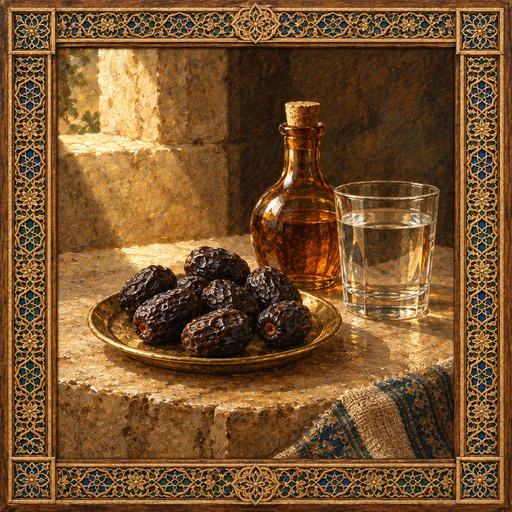
Sahih al-Bukhari 5445 promises protection from poison and magic that day to someone who eats seven dates each morning. Related reports specify dates from Medina's territory and from al-Aliya. A fair examination must retain those qualifications rather than substitute any dates from any source.
Sahih al-Bukhari 5445 · seven Ajwa dates Sahih Muslim 2047a · Medina dates Sahih Muslim 2048 · Ajwa al-Aliya
Muslim interpreters also offer a theological explanation. Al-Ayni records al-Khattabi's view that the protection comes through the blessing of Muhammad's prayer, rather than an ordinary property of dates. Invoking that blessing alone does not independently demonstrate the promised protection. The protective effect would still need evidence before it could support a scientific-miracle argument.
The experimental findings are narrower. A 2017 rat study reported reduced liver injury from carbon tetrachloride after repeated treatment with extract. In 2019, a study of 24 rats found improvements in liver and lung tissue after diclofenac toxicity and extract treatment. Neither study tested seven whole dates in humans, protection throughout a day against poisons generally, or magic.
Elsadek et al. 2017 · Ajwa extract in rats Aljuhani et al. 2019 · diclofenac study in rats
Reducing particular tissue damage in laboratory animals cannot establish the report's protective promise. Nor does missing clinical confirmation logically disprove every possible divine intervention. The warranted conclusion is that these studies do not demonstrate the promised protection and cannot carry the claim of a scientifically verified miracle.
If dates protect against poison, why was Muhammad himself harmed by it? Bukhari 4428 reports him, in his final illness, attributing continuing pain to the poisoned food at Khaybar. That question belongs beside the protection claim. The report does not establish that he ate seven qualifying dates on the morning of that meal. That gap does not verify the promise or make his poisoning irrelevant.
Ordinary language, worldly advice or revelation?
Some Muslim scholars reject scientific-miracle readings altogether. The Andalusian jurist al-Shatibi, who died in 1388, held that the Qur'an must be understood by the usage of the Arabs in whose language it was revealed, and said that those who attributed the natural sciences to it had overstepped the bounds, adding that no report shows the Companions, who knew the Qur'an best, speaking of such things. In our own time the Muslim astrophysicist Nidhal Guessoum has dismissed the theory of the Qur'an's "scientific miraculousness" as "embarrassingly popular yet misguided", while holding that the Qur'an and science need not conflict.
al-Shatibi · al-Muwafaqat, vol. 2, Book of Aims (Arabic) Guessoum 2008 · The Qur'an, science, and the contemporary Muslim discourse (Zygon)
Another Muslim reply distinguishes revelation from ordinary practical judgment. Muslim 2363 reports that Muhammad questioned date-palm pollination, the crop suffered, and he then acknowledged his hearers’ greater knowledge of their worldly affairs. The report treats that agricultural opinion as worldly judgment, rather than revealed science. But Muslim 315a ends by attributing the information about the child to knowledge God had just supplied. Calling every troublesome report ordinary advice does not account for that report’s own claim.
Sahih Muslim 315a · sex determination Sahih Muslim 2363 · date-palm pollination

The stature report illustrates a different kind of claim. Bukhari 3326 describes Adam as sixty cubits tall and a decrease continuing to Muhammad’s time. Published skeletal studies instead show varied human heights, including later increases. Al-Muallimi proposes a sharp reduction at Adam’s descent from Paradise, followed by only a small decline. Bukhari does not state that reduction, and no known dated skeleton identifies Adam. Moving the exceptional height into Paradise offers a theological reconciliation; it supplies no independently verified history of human stature.
Sahih al-Bukhari 3326 · stature Will, Pablos & Stock 2017 · stature, table 3 Rosenstock et al. 2019 · 6,098 skeletons Al-Muallimi · al-Anwar al-Kashifa, p. 258 (Arabic)

Does literary excellence establish revelation?

The Qur’an makes claims about signs and its own authority. In it answers demands for signs by directing them to God and the recited book; challenges doubters to produce a comparable . A claim of revelation still needs grounds for belief. Its existence does not establish its truth.
In Dala'il al-I'jaz, al-Jurjani explains how grammatical relationships, placing words earlier or later, and leaving words unstated shape meaning and force. He offers reasons for judgments of eloquence while defending Qur'anic inimitability. These techniques can be studied, but no universally accepted scale makes this the best possible literature. The further question remains: why must this composition exceed human ability and therefore come from God? The comparison needs a defensible standard, not a conclusion assumed before the reading begins.
al-Jurjani · word order, §§103–104 (Arabic) al-Jurjani · omission, §§142–150 (Arabic)
The distinction matters for Christian books too. Renan called Luke “the most beautiful book there is,” while his memoirs describe his departure from supernatural Christian belief. This is one critic's judgment, not an objective ranking of every book. It shows why literary admiration and belief in a text's divine authority remain different judgments. A reader can esteem Luke above the Qur’an without accepting Christianity. Neither admiration nor the rejection of admiration settles divine authorship.
Renan 1877 · Les Évangiles, chapter XIII (French) Renan · Recollections of My Youth
Buried trees, changing clocks and the biblical account
Evidence can support confidence in Scripture without compelling every reader’s assent or proving every biblical claim at once. The Israel Museum dates the Great Isaiah Scroll to about 125 BC, before Jesus: Christians did not compose those passages after his life. Babylonian records identify Belshazzar as Nabonidus’s son and regent; excavated Hittite archives attest that civilization. These are particular, checkable connections with the biblical world, rather than a demand to accept every historical claim without examination.
Israel Museum · Great Isaiah Scroll exhibition British Museum · Belshazzar, crown prince and regent UNESCO · Hittite tablets from Boğazköy
Deep burial is real, but depth alone does not identify its cause or duration. Pompeii’s excavation authority records about three metres of pumice and lapilli during the first phase of the AD 79 eruption, followed by a hot pyroclastic current. Çatalhöyük’s management plan describes 21 metres of deposits and houses repeatedly built over earlier houses. Sudden volcanic burial and repeated rebuilding leave different records. The sediment, occupation sequence and correlation with other sites must distinguish the proposed histories.
Pompeii Archaeological Park · eruption burial Çatalhöyük management plan · deposits and rebuilding, pp. 10–13
Fossil trees crossing several beds likewise deserve a concrete explanation. Young-earth Christians rightly ask how trunks survived while sediment accumulated. At Joggins, fieldworkers document rooted standing trees amid sandstone and mudstone, with relatively rapid sedimentation. They interpret the burial as repeated episodes; rooted surfaces, renewed vegetation and intervening structures distinguish successive forests from transported logs. The trunks do not require immense intervals between every adjoining bed. Establishing the history of the whole formation, or connecting different forests to one Flood, requires further evidence.
Calder et al. 2006 · Joggins fossil forests Rygel et al. 2004 · sediment structures around plants Oard & Giesecke 2007 · young-earth interpretation
Marine fossils near Everest’s summit are real too. Sakai and colleagues identified fragments of trilobites, crinoids and ostracods within limestone, supporting a marine origin. Young-earth Flood geologists propose deposition followed by rapid uplift; their account need not put seawater above today’s Everest. The same study records faults and isotope-based mineral ages from the underlying Yellow Band. Those ages concern its thermal history, rather than directly dating the fossils’ deaths. A proposed recent Flood sequence and a longer tectonic history must each explain the strata, structural relationships and chronological evidence.
Sakai et al. 2005 · Everest summit limestone Snelling 2021 · Flood deposition and later uplift
Earth’s magnetic field has weakened in recent centuries. Creationist physicist D. Russell Humphreys argues that declining observable magnetic energy supports a young Earth, including both dipole and non-dipole energy in his calculation. An age still requires a model of the system before measurements began. USGS explains how convection of liquid metal in the core can replenish magnetic energy. Recent decline alone does not establish continuous free decay throughout the past; the competing histories must account for energy sources and the measured field.
NASA · observed geomagnetic weakening Humphreys 2002 · the magnetic-energy argument USGS · how the core generates the field
Magnetic shielding also affects atmospheric carbon-14 production. Andrew Snelling argues that lower initial carbon-14 and a different pre-Flood carbon inventory could make young material appear much older. Calibrated dating already addresses changing atmospheric concentrations through comparison with dated tree rings and other archives. IntCal20’s securely dated tree-ring section extends beyond 12,000 calendar years; older sections involve further alignment and modeling. Those assumptions and uncertainties can be examined. Production changes do not invalidate every calibrated date, and carbon-14 is not the method used to date Earth at billions of years.
Snelling 2011 · magnetic shielding and initial carbon-14 Oxford Radiocarbon Accelerator Unit · calibration Reimer et al. 2020 · IntCal20 calibration

The Moon recedes by about 3.8 centimetres per year today. Creationist Jonathan Henry projects a distance-dependent tidal model backward with a fixed coefficient. Under those assumptions his calculation gives an upper limit of about 1.3 billion years; it does not derive a six-thousand-year age. Past dissipation depends on ocean geometry and resonances. Farhat and colleagues model those changes, but also use an estimated lunar formation age as a fitting input. Their fit therefore does not independently measure that age. Present recession alone does not settle the full history.
NASA Moon Fact Sheet · present recession Henry 2006 · lunar recession argument (updated page) Farhat et al. 2022 · resonant tidal evolution
Population growth and genetic differentiation have no single fixed speed. Births, deaths, migration and selection affect the result; the UN records populations declining while others grow. Nathaniel Jeanson argues for recent origins from pedigree mutation rates and genetic family trees. Separately, a 2024 mitochondrial study documents how drift and selection affect whether new variants persist: mutations and long-term substitutions are different quantities. Jeanson’s 2019 Y-chromosome analysis assigns a post-Flood span of 4,206–4,636 years when dating branches. Its demographic comparison tests consistency within that timeline, rather than independently discovering the Flood’s date.
UN DESA 2024 · changing population trends Jeanson 2019 · Y-chromosome population-clock argument Árnadóttir et al. 2024 · mitochondrial mutations in pedigrees
A physical account of burial or mountain building does not itself exclude God. A difficulty in one proposed history does not establish another without evidence for it. Christians confess the Creator while examining human interpretations of nature. Evidence remains evidence when someone rejects it; our understanding can still be mistaken. The same care belongs in evaluating a claimed Qur’anic scientific miracle and a proposed scientific confirmation of a biblical event.
The question that can be tested.
The Bible exposes prophetic claims to facts: Deuteronomy says that a prediction which fails was not spoken by God. In Matthew 12, Jesus points to the sign of Jonah, connecting his mission with death and deliverance. Paul then makes the resurrection decisive for the truth of Christian faith:
And if Christ be not raised, your faith is vain; ye are yet in your sins.
Did Jesus die and rise again? Paul does not protect that claim by changing the meaning of resurrection whenever it is questioned. He says Christian faith would fail if it were false. This is the evidence we invite you to examine: the witnesses to Christ and the life he offers through his victory over death.

Christian faith joins reasons for belief with trust in the God who speaks. Second Peter contrasts invented stories with apostolic eyewitness testimony, then directs attention to prophetic Scripture spoken through the Holy Spirit. It joins testimony and God's word. Proverbs calls us to trust the Lord rather than make our own understanding supreme. That trust should not be transferred automatically to anyone who claims to speak for God.
Athanasius’s Life of Antony 77 records Antony placing faith’s inward working above the learned art of philosophical demonstration. His surrounding conversation still reasons about Christ and appeals to his deeds. Faith can entrust itself to God beyond complete understanding while giving reasons for that trust.
Nor does faith reduce to winning an argument. In John Jesus says that coming to him depends on the Father's drawing; in Peter stays because Jesus has the words of eternal life. We examine reasons, but we also need God's grace. Second Timothy therefore commands the Lord's servant to teach patiently and gently, looking to God to grant repentance and knowledge of the truth. We can speak plainly for Christ without contempt, and offer reasons without pretending that our rhetoric can convert a heart.
Go to the sources.
Complete source list(86)
M. Pickthall · English translation
Qur’an 29:50–51
50And they say: Why are not portents sent down upon him from his Lord? Say: Portents are with Allah only, and I am but a plain warner.
51Is it not enough for them that We have sent down unto thee the Scripture which is read unto them? Lo! herein verily is mercy, and a reminder for folk who believe.
M. Pickthall · English translation
Qur’an 2:23
23And if ye are in doubt concerning that which We reveal unto Our slave (Muhammad), then produce a surah of the like thereof, and call your witness beside Allah if ye are truthful.
King James Version
2 Peter 1:16–21
16For we have not followed cunningly devised fables, when we made known unto you the power and coming of our Lord Jesus Christ, but were eyewitnesses of his majesty.
17For he received from God the Father honour and glory, when there came such a voice to him from the excellent glory, This is my beloved Son, in whom I am well pleased.
18And this voice which came from heaven we heard, when we were with him in the holy mount.
19We have also a more sure word of prophecy; whereunto ye do well that ye take heed, as unto a light that shineth in a dark place, until the day dawn, and the day star arise in your hearts:
20Knowing this first, that no prophecy of the scripture is of any private interpretation.
21For the prophecy came not in old time by the will of man: but holy men of God spake as they were moved by the Holy Ghost.
King James Version
Proverbs 3:5–6
5¶ Trust in the LORD with all thine heart; and lean not unto thine own understanding.
6In all thy ways acknowledge him, and he shall direct thy paths.
King James Version
John 6:44–45
44No man can come to me, except the Father which hath sent me draw him: and I will raise him up at the last day.
45It is written in the prophets, And they shall be all taught of God. Every man therefore that hath heard, and hath learned of the Father, cometh unto me.
King James Version
John 6:66–69
66¶ From that time many of his disciples went back, and walked no more with him.
67Then said Jesus unto the twelve, Will ye also go away?
68Then Simon Peter answered him, Lord, to whom shall we go? thou hast the words of eternal life.
69And we believe and are sure that thou art that Christ, the Son of the living God.
King James Version
2 Timothy 2:24–25
24And the servant of the Lord must not strive; but be gentle unto all men, apt to teach, patient,
25In meekness instructing those that oppose themselves; if God peradventure will give them repentance to the acknowledging of the truth;
M. Pickthall · English translation
Qur’an 23:12–14
12Verily We created man from a product of wet earth;
13Then placed him as a drop (of seed) in a safe lodging;
14Then fashioned We the drop a clot, then fashioned We the clot a little lump, then fashioned We the little lump bones, then clothed the bones with flesh, and then produced it as another creation. So blessed be Allah, the Best of creators!
King James Version
Isaiah 40:22
22It is he that sitteth upon the circle of the earth, and the inhabitants thereof are as grasshoppers; that stretcheth out the heavens as a curtain, and spreadeth them out as a tent to dwell in:
King James Version
Job 26:7
7He stretcheth out the north over the empty place, and hangeth the earth upon nothing.
King James Version
Psalms 139:13–16
13For thou hast possessed my reins: thou hast covered me in my mother’s womb.
14I will praise thee; for I am fearfully and wonderfully made: marvellous are thy works; and that my soul knoweth right well.
15My substance was not hid from thee, when I was made in secret, and curiously wrought in the lowest parts of the earth.
16Thine eyes did see my substance, yet being unperfect; and in thy book all my members were written, which in continuance were fashioned, when as yet there was none of them.
King James Version
Deuteronomy 18:21–22
21And if thou say in thine heart, How shall we know the word which the LORD hath not spoken?
22When a prophet speaketh in the name of the LORD, if the thing follow not, nor come to pass, that is the thing which the LORD hath not spoken, but the prophet hath spoken it presumptuously: thou shalt not be afraid of him.
King James Version
Matthew 12:38–40
38¶ Then certain of the scribes and of the Pharisees answered, saying, Master, we would see a sign from thee.
39But he answered and said unto them, An evil and adulterous generation seeketh after a sign; and there shall no sign be given to it, but the sign of the prophet Jonas:
40For as Jonas was three days and three nights in the whale’s belly; so shall the Son of man be three days and three nights in the heart of the earth.
King James Version
1 Corinthians 15:14–17
14And if Christ be not risen, then is our preaching vain, and your faith is also vain.
15Yea, and we are found false witnesses of God; because we have testified of God that he raised up Christ: whom he raised not up, if so be that the dead rise not.
16For if the dead rise not, then is not Christ raised:
17And if Christ be not raised, your faith is vain; ye are yet in your sins.
M. Pickthall · English translation
Qur’an 86:6–7
6He is created from a gushing fluid
7That issued from between the loins and ribs.
M. Pickthall · English translation
Qur’an 16:15
15And He hath cast into the earth firm hills that it quake not with you, and streams and roads that ye may find a way.
M. Pickthall · English translation
Qur’an 21:31
31And We have placed in the earth firm hills lest it quake with them, and We have placed therein ravines as roads that haply they may find their way.
M. Pickthall · English translation
Qur’an 18:86
86Till, when he reached the setting-place of the sun, he found it setting in a muddy spring, and found a people thereabout. We said: O Dhu'l-Qarneyn! Either punish or show them kindness.
M. Pickthall · English translation
Qur’an 23:13–14
13Then placed him as a drop (of seed) in a safe lodging;
14Then fashioned We the drop a clot, then fashioned We the clot a little lump, then fashioned We the little lump bones, then clothed the bones with flesh, and then produced it as another creation. So blessed be Allah, the Best of creators!
King James Version
1 Corinthians 15:17
17And if Christ be not raised, your faith is vain; ye are yet in your sins.
King James Version
John 6:44
44No man can come to me, except the Father which hath sent me draw him: and I will raise him up at the last day.
King James Version
John 6:68
68Then Simon Peter answered him, Lord, to whom shall we go? thou hast the words of eternal life.
# PLEASE DO NOT REMOVE OR CHANGE THIS COPYRIGHT BLOCK
#====================================================================
#
#  Tanzil Quran Text (Uthmani, Version 1.1)
#  Copyright (C) 2007-2026 Tanzil Project
#  License: Creative Commons Attribution 3.0
#
#  This copy of the Quran text is carefully produced, highly
#  verified and continuously monitored by a group of specialists
#  at Tanzil Project.
#
#  TERMS OF USE:
#
#  - Permission is granted to copy and distribute verbatim copies
#    of this text, but CHANGING IT IS NOT ALLOWED.
#
#  - This Quran text can be used in any website or application,
#    provided that its source (Tanzil Project) is clearly indicated,
#    and a link is made to tanzil.net to enable users to keep
#    track of changes.
#
#  - This copyright notice shall be included in all verbatim copies
#    of the text, and shall be reproduced appropriately in all files
#    derived from or containing substantial portion of this text.
#
#  Please check updates at: http://tanzil.net/updates/
#
#====================================================================
Word meaning · Arabic
عَلَقَة
ʿalaqa
Something that clings; also a leech, and a clot or piece of congealed blood.
In this context
Qur’an 23:14 places the ʿalaqa after the drop and before the mudgha. Pickthall renders it “a clot.” The leech and blood senses are both recorded in classical lexicons; the chapter tests the scientific claim made from these comparisons.
Word meaning · Arabic
مُضْغَة
mudgha (muḍgha)
A morsel of flesh, as much as is chewed at one time.
In this context
In Qur’an 23:14 it names the stage after the ʿalaqa, as al-Raghib also explains. Pickthall renders it “a little lump”; some modern readings stress “chewed.”
Word meaning · Arabic
حَامِيَة
hamiyah (ḥāmiya)
Hot.
In this context
The other received reading of 18:86: “a hot spring.” Ibn Kathir, citing al-Tabari, accepts both readings and sees no contradiction between their meanings.
Word meaning · Arabic
حَمِئَة
hami'ah (ḥamiʾa)
Full of black mud (ḥamʾa); muddy.
In this context
One received reading of Qur’an 18:86: Dhu al-Qarnayn found the sun setting “in a muddy spring.”
Word meaning · Arabic
الحَدِيث
hadith (ḥadīth)
A report or account. In Islamic usage, a transmitted report of what Muhammad said or did.
In this context
Used for the reports gathered in collections such as al-Bukhari’s and Muslim’s. These readings treat them as secondary to the Qur’an.
Word meaning · Arabic
عَجْوَة
Ajwa (ʿajwa)
A choice variety of date grown in Medina.
In this context
Bukhari 5445 promises protection from poison and magic for that day to whoever eats seven Ajwa dates in the morning.
Word meaning · Hebrew
חוּג
ḥûg
Circle, circuit or vault. Strong’s lists circle, circuit and compass; Brown–Driver–Briggs gives vault.
In this context
Isaiah 40:22 describes God’s rule over his creation in striking poetry. The noun does not by itself specify a complete geometric or cosmological model. The Arabic Van Dyck translation uses “sphere of the earth” here, where the KJV has “circle of the earth”.
Word meaning · Arabic
سُورَة
surah (sūra)
A chapter of the Qur’an. Al-Raghib compares it to a city wall (sūr) that encloses, or to a rank or station.
In this context
Qur’an 2:23 challenges doubters to produce a surah like it; the readings also refer to surahs by number.