THE QUESTION BEFORE US
Did Jesus merely point toward salvation, or did he come to save us?
Choose a verse number, book icon or underlined word to read more here.
The cross was there from the beginning.
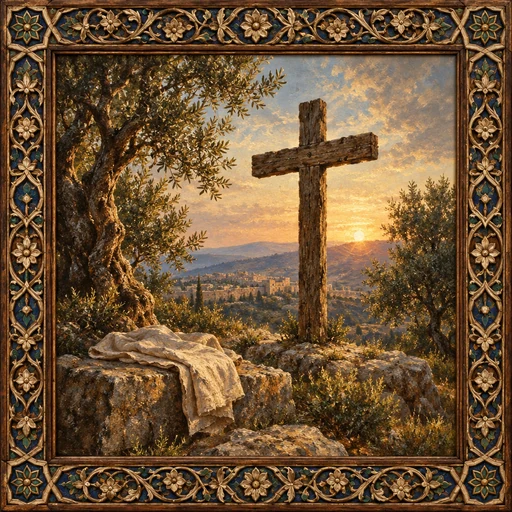
The Christian gospel begins with an event: Jesus Christ died for our sins, was buried, and rose again. In 1 Corinthians , Paul passes on the proclamation he had received and names people to whom Christ appeared: Cephas, the Twelve, James, the apostles, and Paul himself. He also reports an appearance to more than five hundred, most of whom, he says, were still alive. The letter is usually dated to the mid-50s AD, about twenty-five years after the crucifixion, and Paul is repeating a message he had already delivered. The cross and resurrection belong to this earliest generation’s proclamation.
1 Corinthians 15:1–8 1 Corinthians · historical introduction

These are claims about named, identifiable witnesses. In Galatians , Paul says he stayed with Cephas and met James, the Lord’s brother. His account connects him with the people at the center of the movement. The five hundred are a group reported by Paul, not five hundred separately preserved statements; the evidence is still concrete enough to demand an explanation.
The one who gives his life.

The Gospels give this saving death a meaning in Jesus’ own teaching. In Mark, he rejects the pattern of rulers who dominate others and says that the Son of man came to serve and give his life as a . He does not merely prescribe a path by which the guilty might climb up to God. He gives himself for them.
For even the Son of man came not to be ministered unto, but to minister, and to give his life a for many.

John opens by identifying as God and then declaring that became flesh. At the other end of the Gospel, Thomas sees the risen Jesus’ wounds and addresses him as . Jesus answers by commending belief. The confession of Christ’s divine identity is part of the Gospel’s account, not a later annotation that a reader can remove while leaving its message intact.
Was a prophet turned into a divine Savior?

A Muslim may accept Jesus as Messiah while arguing that his followers transformed a human messenger into the divine Son and replaced his message with a theology of the cross. That explanation makes a historical claim: the earlier Jesus was different from the Jesus proclaimed in the surviving apostolic writings. It must therefore account for those writings, rather than assume their central teaching false because it conflicts with a later account.

The Qur’an itself offers a different account in 4:157–158: Jesus’ opponents did not kill or crucify him; it was made to appear so, and God raised him to himself. A Muslim trusts this as revelation correcting the Christian account. That is the central disagreement, not a dispute about whether Christians esteem a prophet.




Grace for a guilty conscience.

The cross answers a personal question as well as a historical one: how can sinners be reconciled to a holy God? Romans says Christ died for us while we were still sinners. Ephesians describes salvation as God’s gift, received through faith, not a wage earned by works. Good works follow a life made new; they do not purchase the mercy Christ gives.

Jesus calls us to repent and believe the gospel, and invites the weary to come to him for rest. You do not need to settle every argument on this site before opening a Gospel. Read Mark or John, listen to Jesus, and ask whether the Savior who gave his life for sinners is the one in whom you can place your trust.
Go to the sources.
Complete source list(17)
King James Version
1 Corinthians 15:1–8
1Moreover, brethren, I declare unto you the gospel which I preached unto you, which also ye have received, and wherein ye stand;
2By which also ye are saved, if ye keep in memory what I preached unto you, unless ye have believed in vain.
3For I delivered unto you first of all that which I also received, how that Christ died for our sins according to the scriptures;
4And that he was buried, and that he rose again the third day according to the scriptures:
5And that he was seen of Cephas, then of the twelve:
6After that, he was seen of above five hundred brethren at once; of whom the greater part remain unto this present, but some are fallen asleep.
7After that, he was seen of James; then of all the apostles.
8And last of all he was seen of me also, as of one born out of due time.
King James Version
Galatians 1:18–19
18Then after three years I went up to Jerusalem to see Peter, and abode with him fifteen days.
19But other of the apostles saw I none, save James the Lord’s brother.
King James Version
Mark 10:42–45
42But Jesus called them to him, and saith unto them, Ye know that they which are accounted to rule over the Gentiles exercise lordship over them; and their great ones exercise authority upon them.
43But so shall it not be among you: but whosoever will be great among you, shall be your minister:
44And whosoever of you will be the chiefest, shall be servant of all.
45For even the Son of man came not to be ministered unto, but to minister, and to give his life a ransom for many.
King James Version
John 1:1–14
1In the beginning was the Word, and the Word was with God, and the Word was God.
2The same was in the beginning with God.
3All things were made by him; and without him was not any thing made that was made.
4In him was life; and the life was the light of men.
5And the light shineth in darkness; and the darkness comprehended it not.
6¶ There was a man sent from God, whose name was John.
7The same came for a witness, to bear witness of the Light, that all men through him might believe.
8He was not that Light, but was sent to bear witness of that Light.
King James Version
John 20:24–29
24¶ But Thomas, one of the twelve, called Didymus, was not with them when Jesus came.
25The other disciples therefore said unto him, We have seen the Lord. But he said unto them, Except I shall see in his hands the print of the nails, and put my finger into the print of the nails, and thrust my hand into his side, I will not believe.
26¶ And after eight days again his disciples were within, and Thomas with them: then came Jesus, the doors being shut, and stood in the midst, and said, Peace be unto you.
27Then saith he to Thomas, Reach hither thy finger, and behold my hands; and reach hither thy hand, and thrust it into my side: and be not faithless, but believing.
28And Thomas answered and said unto him, My Lord and my God.
29Jesus saith unto him, Thomas, because thou hast seen me, thou hast believed: blessed are they that have not seen, and yet have believed.
King James Version
Luke 1:1–4
1Forasmuch as many have taken in hand to set forth in order a declaration of those things which are most surely believed among us,
2Even as they delivered them unto us, which from the beginning were eyewitnesses, and ministers of the word;
3It seemed good to me also, having had perfect understanding of all things from the very first, to write unto thee in order, most excellent Theophilus,
4That thou mightest know the certainty of those things, wherein thou hast been instructed.
King James Version
John 19:35
35And he that saw it bare record, and his record is true: and he knoweth that he saith true, that ye might believe.
King James Version
Romans 5:8
8But God commendeth his love toward us, in that, while we were yet sinners, Christ died for us.
King James Version
Ephesians 2:8–9
8For by grace are ye saved through faith; and that not of yourselves: it is the gift of God:
9Not of works, lest any man should boast.
King James Version
Mark 1:15
15And saying, The time is fulfilled, and the kingdom of God is at hand: repent ye, and believe the gospel.
King James Version
Matthew 11:28
28¶ Come unto me, all ye that labour and are heavy laden, and I will give you rest.
King James Version
John 21:24
24This is the disciple which testifieth of these things, and wrote these things: and we know that his testimony is true.
M. Pickthall · English translation
Qur’an 4:157
157And because of their saying: We slew the Messiah, Jesus son of Mary, Allah's messenger - they slew him not nor crucified him, but it appeared so unto them; and lo! those who disagree concerning it are in doubt thereof; they have no knowledge thereof save pursuit of a conjecture; they slew him not for certain.
M. Pickthall · English translation
Qur’an 4:158
158But Allah took him up unto Himself. Allah was ever Mighty, Wise.
King James Version
Mark 10:45
45For even the Son of man came not to be ministered unto, but to minister, and to give his life a ransom for many.
# PLEASE DO NOT REMOVE OR CHANGE THIS COPYRIGHT BLOCK
#====================================================================
#
#  Tanzil Quran Text (Uthmani, Version 1.1)
#  Copyright (C) 2007-2026 Tanzil Project
#  License: Creative Commons Attribution 3.0
#
#  This copy of the Quran text is carefully produced, highly
#  verified and continuously monitored by a group of specialists
#  at Tanzil Project.
#
#  TERMS OF USE:
#
#  - Permission is granted to copy and distribute verbatim copies
#    of this text, but CHANGING IT IS NOT ALLOWED.
#
#  - This Quran text can be used in any website or application,
#    provided that its source (Tanzil Project) is clearly indicated,
#    and a link is made to tanzil.net to enable users to keep
#    track of changes.
#
#  - This copyright notice shall be included in all verbatim copies
#    of the text, and shall be reproduced appropriately in all files
#    derived from or containing substantial portion of this text.
#
#  Please check updates at: http://tanzil.net/updates/
#
#====================================================================
Word meaning · Greek
λύτρον
lytron
A ransom: the price paid to set someone free.
In this context
Mark 10:45: the Son of man came “to give his life a ransom for many” (λύτρον ἀντὶ πολλῶν).
Word meaning · Greek
λόγος
logos
Word, speech, reason. In John’s Gospel, with the article, the divine Word who is Christ.
In this context
John 1:1, 14: “the Word was God” (θεὸς ἦν ὁ λόγος) and “the Word was made flesh.”
Word meaning · Greek
ὁ κύριός μου καὶ ὁ θεός μου
ho kyrios mou kai ho theos mou
“My Lord and my God”: kyrios, lord or master; theos, God.
In this context
Thomas’s words addressed to the risen Jesus in John 20:28; Jesus answers by commending belief.